

The short answer
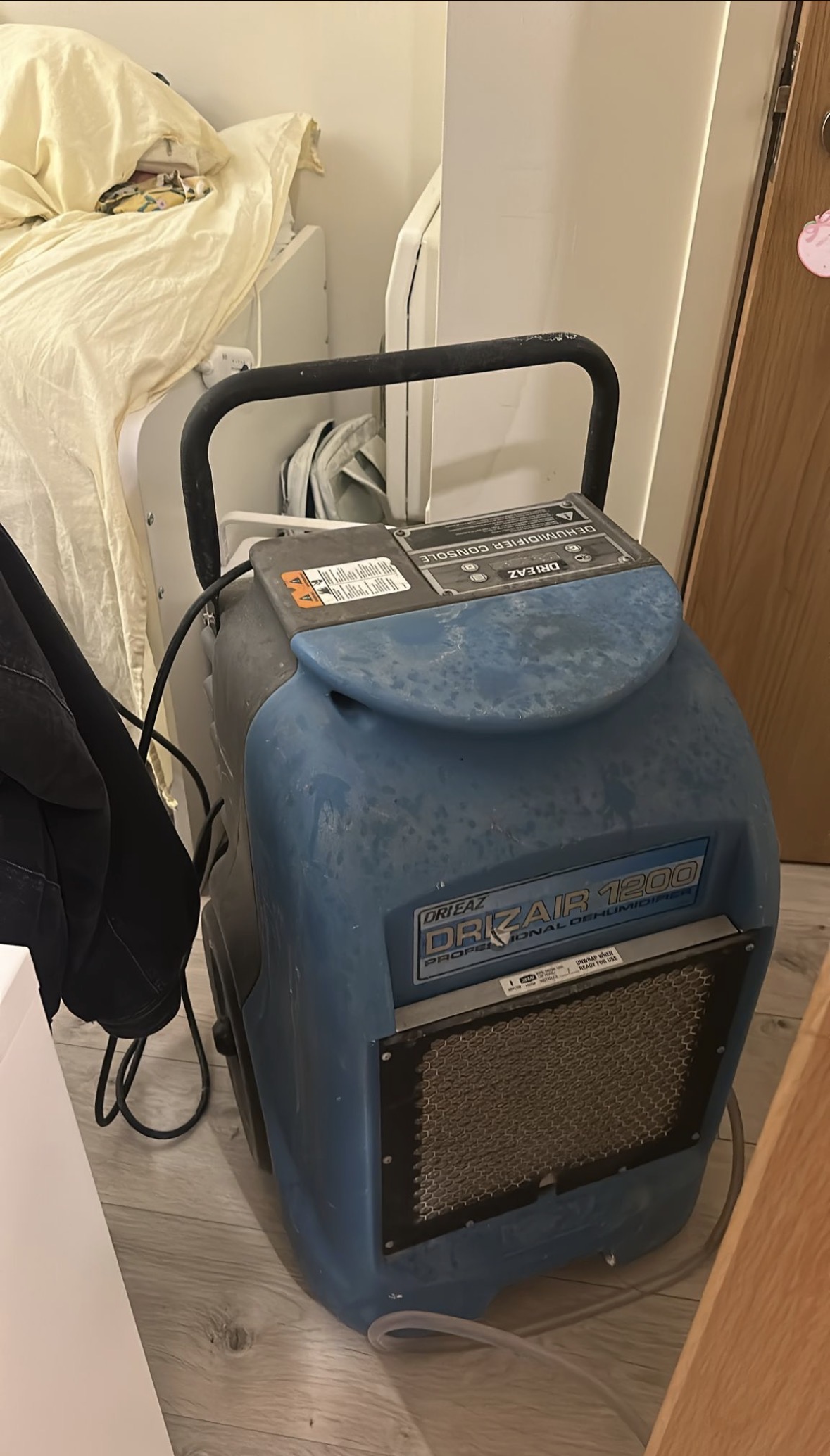
Yes, a dehumidifier can help — but only as part of a setup. On its own, in the middle of a closed room, it will dry the air and then stall, because moisture inside plaster, timber, screed and insulation needs air moving across those surfaces before it will transfer into the air the dehumidifier can reach. Where water has gone into the structure rather than just onto it, a monitored professional setup will usually achieve in days what a domestic unit struggles to achieve at all.
What a dehumidifier actually does
It removes water vapour from the air, nothing else. It cannot reach into a wall or under a floor. Its role is to keep the air dry enough that wet materials keep releasing moisture into it, and to collect that moisture so it does not simply condense somewhere colder in the property.
That means the dehumidifier is only ever half the job. The other half is getting air to move across every wet surface so the moisture has somewhere to go.
When a domestic dehumidifier is genuinely useful
- A small, quickly-contained spill on a hard surface
- A room with damp air after a minor leak that has already been mopped up
- Supporting general drying of soft furnishings in a warm, closed room
- Managing humidity in a small bathroom or utility area after a short overflow
In those situations, run it continuously, keep the room closed so it is working on that air rather than the whole house, and empty it or plumb it to a drain so it does not shut down when full.
Why one unit in a room is often not enough
Water that has been absorbed into building materials sits deep in those materials. It moves toward the surface slowly, and only evaporates once it reaches a surface with moving air across it. Without air movement, a thin layer of moist air sits against the wet surface and effectively insulates it — the dehumidifier lowers the humidity everywhere else in the room while the wall stays wet.
This is why professional drying pairs dehumidification with air movers positioned to sweep across affected surfaces, and why the number and placement of both is decided from the assessment rather than by putting one machine in the middle of the floor.
Extraction comes before drying
If there is still standing water, no amount of dehumidification is the right answer. Physically removing water is many times faster and cheaper than evaporating it. Extraction first, drying second — always in that order.
Different materials behave differently
- Plasterboard gives up surface moisture quickly but can hide wet insulation behind it
- Solid plaster and masonry hold a great deal and release it slowly
- Timber releases moisture gradually and can distort if dried too aggressively
- Screed and concrete are among the slowest, and can read dry at the surface while still wet within
- Mineral wool insulation holds water and frequently will not dry in place at all
- Carpet underlay rarely recovers once thoroughly soaked
A drying plan that works for a plasterboard partition will not do much for a screed floor. That is the practical reason equipment choice follows the assessment rather than the other way round.
Doors and windows — it depends on the setup
There is no universal rule, and this is where a lot of well-meant advice goes wrong.
- With a dehumidifier running, keep the room closed. Open windows let in outdoor air and the machine ends up dehumidifying the outside world.
- Without any equipment, and in mild dry weather, ventilation is better than nothing — open windows and internal doors to keep air moving.
- In cold or wet weather, open windows can make things worse by cooling surfaces and encouraging condensation.
- If a professional drying setup is installed, follow the specific instructions for it. The equipment is positioned as a system and moving or switching things off changes how it performs.
Monitoring is what turns drying into progress
Running equipment without measuring is guesswork. Readings taken over time show whether materials are actually giving up moisture. If readings plateau, something needs to change — usually access to a trapped area, rather than simply more machines.
Safety — where to stop
Please do not run electrical equipment in or near standing water, and do not plug anything into a socket that has been wet until an electrician has checked it. If the water came from a drain, a toilet, or floodwater from outside, treat it as contaminated: that is not a DIY drying job, and protective handling matters more than speed.
What not to do
- Do not run a dehumidifier with the windows open.
- Do not point a domestic fan at a wet wall and assume that is air movement — placement matters.
- Do not switch equipment off overnight to save electricity; drying is a continuous process.
- Do not use heaters to force drying, which can drive moisture into cooler parts of the building.
- Do not attempt DIY drying where water may be contaminated or where electrics have been affected.
Common questions
How My HomeDry can help
Related guides
- What actually happens during structural drying?The full process explained step by step — inspection, assessment, extraction, equipment, monitoring and completion.
- How long does a house take to dry after a leak?Why there is no single answer, what actually changes the timescale, and why 'it feels dry' is not the same as dry.
- How can you tell if a wall is still wet?The visible signs worth noticing, what they do and do not prove, and why appearance alone is an unreliable test.
This guide provides general property water-damage information from My HomeDry. Individual circumstances differ, and it is not financial, legal or insurance advice. Where an insurance claim is involved, decisions on liability, policy coverage and settlement rest with the insurer under the terms of the individual policy.